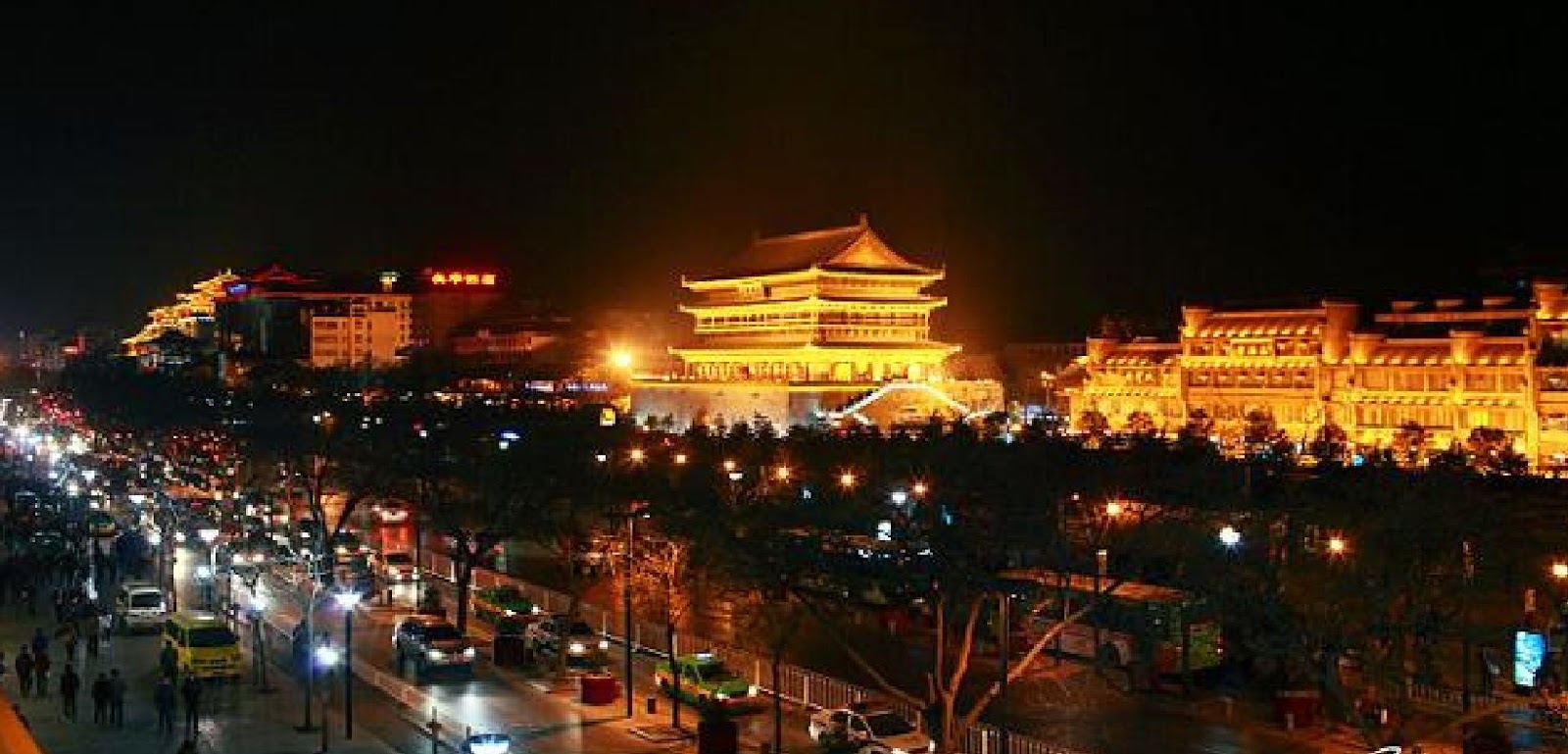
Silk Road, the ancient route for silk and spice trading, started from ancient Chang'an (now the city of Xi'an in the middle of China). It traveled west through Wuwei, Yumen, Dunhuang, Turpan, to Kashgar, the city at the west end border of China. It then passed through the Pamirs and ancient Persia, crossed the Mediterranean, and eventually reached the European Inland Rome.
I was born in the middle of the Silk Road in Yumen, grew up in Xi’an, the starting point of Silk Road. Last summer, we traveled from Kashgar to Yumen and Dunhuang. I finally feel I appreciate the Silk Road a little bit more. Although my understandings are mostly based on trivial details, it was a great time exploring and revisiting the good food along the way.
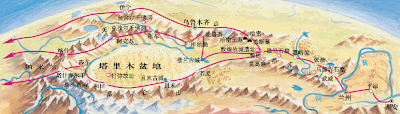 |
| Map of Silk Road |
 |
| Artifact from Tang Dynasty, when camels were portrayed as tall as five humans stacked together. Understandable, who else could get them through the thousand miles of desert land? |
1. XI'AN (西安)
Xi'an is the gourmet capital city of the Silk Road. It flourished during the Tang Dynasty 1300 years ago. During these years, people accumulated all sorts of wisdom to enjoy the food from their field and from the trade. I can sit here counting good eats by going through my finger for many rounds. Stewed pork in a crusty white bread bun, lamb stew with crushed bread, lamb stew with clear soup, hot oil-sprinkled noodles, hot and sour noodle with mixed vegetable sauce, sour soup dumplings, rice or wheat jelly with hot sauce, cold buckwheat noodle in hot and sour sauce, vegetable stew with lamb meatball, lamb oil fried flour porridge, crispy bread baked on hot cobbles, jujube cake, mirror cake, persimmon cake, etc. I am drooling as I count my fingers.
 |
| South Gate of Xi'an. this city is still surrounded by its original thick brick wall for defending enemies. Now a days, all the traffic still has to go through these narrow gates in order to get to downtown. |
 |
| Jujube Cake in the night market - one yuan (15 cents) will get you a wedge of these sweet treat |
Last spring during the Chinese New Year, we went back to Xi'an to revisit the places and the good food that were dear to our memories, which of course includes the jujube cake and the persimmon cake.
It was dawn; the sky was still golden behind the tall ancient–style buildings. We strolled along the Muslim street with the rest of the bustling crowd. There were a wide range of store fronts along the narrow street, selling specialty food, snacks and refreshments. It was very noisy with vendors shouting with all sorts of accents, including Uygurs, to attract customers buy things. The whole street smelled like dry nuts and a mysterious mix of spice. Then at one spot, there was this strong aroma of fried osmanthus flower. That was the place for persimmon cake. When I was a little kid, my favorable thing during the autumn mornings was to go out and get warm persimmon cake. Little red persimmon is one of the local specialty in the area. These sweet fruits are round and petite; they look like little lanterns when fully ripe. To make the batter for the persimmon cake, the vender grabs the little red lanterns, squeezes out the meat and juice from each of them into the flour. Then he mixes the batter evenly after sprinkle some dried osmanthus flower. Once the batter is ready, he uses a big flat iron spoon to scoop some of those soft batter, scraps the edge of the spoon with a spandrel. The flat spoon is then dipped into a deep pot with hot oil. As the hot oil bubbles with smoke, the fragrance of the flower comes out. Then gently, a red persimmon cake swims to the top from underneath. The vender scoops it up; puts it aside for it to cool down a little before it can be touched. I typically buy half a dozen, and finish each one in two bites. It has a crispy shell after the deep frying, and the inside is as soft as the persimmon Now a days, those persimmon cakes gets advanced with all sorts of stuffing, like red bean, sesame stuffing, dry rose pedals, and mixed nuts. But the dough wrapping outside is still authentic and tasty.
 |
| Muslim selling persimmon cakes |
One of the must-eat is stewed pork in a crusty white bread. It is more like a american sandwich. Using a tall big stockpot, the cook stews big chucks of pork belly meat, leg meat with a variety of spices for hours until the sauce gets thick and brown. After you place the order, the cook holds a big scoop, grab one piece of meat and put it on a big round chopping board, which is made from strong tree stub. There are thick gravy dripping on the counter and on the board. The chopping board concave to the center, so the gravy and meat get mixed together during the chopping. From another pot on the stove, he then picks up a flat baked bread, slices it into two half, leaving one side of the two slices attached. Then using a big rectangular kitchen knife, he picks up the minced meat, lays them into the open warm bread. Now it is ready. Of course, the best place for this special sandwich is the Fan's at the Bamboo Fence street. The best spot is outside the store under the eaves of the building (there is no chair to sit down). To eat like a authentic western style person, you hold your sandwich, squat down, open up and bite into the hard shelled bread. As the mixed flavor of delicious stewed meat and sweet wheat texture fills you mouth, you can watch the brown gravy and oil flowing down from the edge of the bread to your fingers and palm, then dropping to the ground. It usually does not take long to finish this meaty sandwich. Then you can lick you finger if you like, or wipe both hands on your jeans. It is now time to continue the stroll to see other special features of this old city.

The city of Xi'an is a square surrounded by original walls from ancient time. Bell Tower is in the center of the square and four major streets radiate from here toward the four gates in the four directions. The most popular places are definitely East Main Street and South Main Street. But to eat authentic local dishes, you have to go to those no-name alleys to find those small Papa and Mama stores. Last winter, we had a local friend drove us around so we get to eat the best local food in town. Our friend's car was not big but we still had to do some walking because the alleys were so narrow the car could not get in. One of the small place is really well known for its stewed lamb soup. This special dish has another name called lamp in a water basin, because the the soup bowl is as big as a wash basin. The soup is clear, the aroma is fresh with clean meat and green spices, and it taste delicious paired with crusty white bread, hot chili sauce and sugar pickled garlic. The place only opens for breakfast. After 11AM, the family close up the store, go home to live their own private life. The store is usually fully packed with customers burying their heads in the big bowls. In between the big tables, the son and the daughter are busy walking around the big tables serving and cleaning. The dad usually stands in front of the big steaming stove with a pot as big as a truck tire, the mother is in the front, taking orders and collecting money. When I was sitting there, holding up my big bowel, tilted it and swallowing a big gulp of warm soup from the side of the bowel, I felt a great sense of frontier land. This is how people supposed to eat in the old days, when land was dry, meal was sparse and people were heroic.
 |
| Lamb in a water basin |
Another small eatery I like serves vegetable stew with meatball for breakfast only, of course paired with same type of white bread. The big soup pot/basin is placed in front of the store above a round stove. When you walk into the store, it is always the first thing that catches you eyes. The pot looks dark, burned on the bottom and the side from the flames, the big spoon looks awfully big and worn. It is definitely not the cleanest cooking utensils ever. The content also looks mysterious, some sort of tofu, cabbage, and others floating in the thick gooey soup base. Looks not appetizing at all.But still, people line up at the register to buy tickets for a bowel of these stew. Some people even bring their own stock pot to carry the soup home. After you get your ticket, there is another line in front of the lady holding the big scoop. She stirs in the pot for several circles and then pour a bunch of bowls that lined up on the counter. It feels like a school cafeteria, but the soup was surprisingly good. The peppery flavor is so unique. After you finish a bowl in a cold day, a surge of heat seems to spread from you chest all through you body. It must have saves many lives during the harsh winter of the Gobi desert.
 |
| Mixed vegetable stew for breakfast |
 |
| White bread |
Hot oil sprinkled noodle is the most common flavor of Xi'an. It is a simple meal and really easy to make. First boil the wide noodles, which are usually as wide as a belt. After the cook places the noodle in the bowl, he tops it with some green onion, garlic, salt, and a thick layer of red chilly pepper powder. For the very last but most essential step, the cook scoops out a spoonful of really hot oil, steadily pour it on the red pepper and the garlic. The whole dish sizzles as loud as a fajita pan. There is also a cloud of smoke rising, along with a fragrance of spices. That is it, the whole meal is done, no meat, no vegetable. Sounds rough, right? But ask any local guy who just finished his noodle with a loud noise; who is probably still sweating from all the hot chilly powder, ask him whether people in Xi'an are truly as rough as this noodle. He would probably say, you think we are rough? So what?
 |
| The noodle is about to sizzle with hot oil sprinkled on top |
Yes most of the food in the western region of China are not cuisines like the nine courses meal served in a French restaurant; they are more like a street food, simple, fast, but full of flavor. Just like the local people in the that part of China, their food are practical, rough edged and straight forward. One exception is a not-so-fast dish called crushed bread in stewed lamb soup. The bread is only half cooked when presented at the table, and it is the customer's job to break the hard bread into small pieces. The server then collects the big bowl with crushed bread back to the kitchen. Each bowl is tagged with customer's name. The cook stews the bread in clear lamb soup and add other ingredient such as cilantro and rice noodles. Once it is served back to the table, the bread is fully cooked but saturated with the flavors from the lamb soup. There is no chance of encountering soggy bread after this process. Also, the resilient texture of the bread mixed with heavy soup makes every bite taste like 100% meat . I am always amazed how people figured out this is the way to make bread taste like meat.


Of course things has changed a lot from the old times when I was a little kid. One example is the fun sugar characters that is sold by the street artist. Like making glassware, the guy blowed air into the melted sugar balls to form the animal shape. I would eat it happily in the old time since sugar were precious. But now, NAH, how could I ever licked something so gross?
 |
| The artist is holding a dragon made from sugar |

There was also food that disappointed us. I have always craved for Jia's soup dumpling ever since high school but never had the chance to taste one before last winter. Being a girl that could only do well in the report cards, dump place like the Muslim street was prohibited for me and most of my friends at that time. In the parents' eyes, Muslim people were rude, they carry knifes with them, and they never take showers or wash their hands before they cook food for other people. I still remember one Monday morning during high school recess, my best friend secretly told me that she and her boyfriend went to Muslim street to eat Jia's dumpling. They had to tell their parents that they were doing the school newspaper on the big blackboard to get out of home. They rode their to the Muslim street and spend a whole afternoon there. She had such a great time that she kept on talking about how tasty those dumpling were. The dumplings were small with nice crease in the middle. Inside the almost transparent wrap, there is a big lump of juicy meat. Once you bite into one hot dumpling, a whole spoonful of broth would flow out of the tiny dumpling. If you want to catch that broth with your lips, it will burn your tongue and throat. The best way to eat it is to bite a small opening on the top, wait a little bit to let the steam out, at the same time, take a long sniffing of the aroma, then you suck the hot juice out from the dumpling before finish it. With this image in my head, I drooled for the food, and envies that my friend had a tall and muscular bodyguard so she could go to slums and come back with good memories.
So last year, as soon as I reached Xi'an, I rushed to Muslim street with my husband, my son and a friend. Muslim street has already been developed into a tourist attraction and the sanitary practice has been improved by hundred folds. I finally got to eat Jia's lamb dumplings. Outside of the restaurant, the glazed facade looked so bright and clean. However inside , the young waiter was sleepy, the floor was wet, and most importantly, most of the dumpling had leaked so not much juice has left. The lamb dumpling still taste good but it is a far stretch to reach the expectation that I had built up for decades. Worst yet, after we got back to the hotel, three of us started to fight for bathroom. Something was not right in the food. Watching my Stephen clutching in bed holding his stomach, I couldn't help but thinking, maybe my mom's nagging was right? So this is all I got after so many years of craving? Or maybe I just craved for the freedom to go to places?
2. Lan Zhou (兰州)
Travelling west from Xi'an, Lan Zhou is about 400 miles away. It is important city along the silk road since it is near the yellow river. I lived here for about six month with my family during the early 80s. Food in Lan Zhou share the similar western style as the food in Xi'an. But as the silk road gets closer to the Gobi desert, the food starts to get even more straight forward.
Hand pulled noodle in beef broth is the most typical food in Lan Zhou. The noodle dough is made with a special gray powder ingredient, which is the ash of a common desert grass after burning. The plant ash makes the dough very resilient. When stretched in slow motion, the dough can become really thin noodles without breaking. After the noodle is cooked in boiling water, it is added to the beef broth, then sprinkled with cilantro, green garlic leaves, and red chili sauce. The beef broth is cooked overnight by stewing beef and bones, sometime with radish. It is always ready in the kitchen so the noodle can be brought to the table within couple of minutes. The noodle has a slight tart flavor due to the plant ash, but with the combination of beef, radish and chili, it is perfectly balanced and distinctively remembered.
Now every city in China has several little Lan Zhou noodle shop. For some reason, it always taste good. Just like Campbell's chicken noodle soup never fail to comfort a kid who grew up in America, Lan Zhou noodle is a comforting food for many kids like me. When I was in Lan Zhou, my parents took us to Ma's noodle shop on special occasions such as pay days or family or friends visiting. At that time, the land was barren, it did not produce much for the farmers in the villages; there were famines every year. In the winter and spring, the farmers had to flood into the big city, leaving their wives and kids home with the limited food source. They hangout and sleep near the train station and bus stations where there are roof and sometimes heat. They beg for food during the day, asking for dry bread or left overs from the city folks. And when they were tired, they just sit there, lined up against walls near the side walk, looking straight through the people walking by, into the hollow space. Sometimes the look on their face gave me a sense that there were people among them could not make it back home this year after the land turns green. So when the seven year old me came out of the noodle shop with a full belly, still trying to remember the taste of the chewy noodle and the flavor of the meat, holding my mom and my sister's hand on each side, I thought I was the luckiest kid in my small little world.
 |
| Lan Zhou Noodle |
3. Dun Huang (敦煌)
This used to be a oasis town and frontier outpost right in the middle of the desert. In the long history of the silk road, when people were traveling long distance, battling between life or death by trying hard to get water and food, they really cherished their spiritual world. Merchant donated generously to the monks into their effort of building and painting Mogao Caves in the mountains to celebrate Budda and get blessing from him. The city became famous after the British explorer Aurel Stein displayed the art and manuscript he had brought back to England. Nowadays, it is one of the hottest attraction for Chinese tourist. With money in their hand from the recent prosperity, all Chinese residents want to see the world and take home pictures of themselves standing in front of the attractions. Dunhuang is definitely on the top of the list.
The local people in Dunhuang also benefit greatly from the two million tourists a year. But since tourist industry is relatively new in the area, people are still adjusting to the reality and there is really not much standard. Right after stepping out of the train station, I felt there was great sense of urgency among the local taxi driver and merchants to squeeze whatever money the tourist carries with them. They would really chase you down and squeeze to the bottom. After we negotiated a reasonable price with a cab driver, he told us he had to get some water and walked away. While we were sitting in the car, he came back with two young students passengers and made four of us squeeze in his back seat. Our experience of the drive? Not something he cares. After all, there are still other two million tourist pouring in every year even nobody ever comes back revisit.
We booked a village lodge in the Crescent Spring Village. But because of so many tourists, the lodge was overbooked. So the owner sold us to his not-so-popular neighbor. The host lady is in her early 50's. She host tourist in her own home, which is equipped with traditional ondol bed and shared bathroom. Like most of the local people in the Gobi desert, she is short on words. There was something about her got me into thinking about how the recent prosperity impact the local people, who used to have a simple but rough life. She acted like a capable host and tried to chat with the guests. However, when she talked toward us within three feet, I could easily smell and see that she had not brush her teeth for a long long time. She also despise our complaint about bedbugs and slippery bathrooms. To her, the almost new house and the bathroom with flushing toilet is already far advanced than the typical needs of the area. She refuse to understand city slickers like us. Apparently she is still struggling between the wave of easy money and the urge to not let the wave change her into someone that she does not want to be.
 |
| Sand Dunes near the Crescent Spring Village |
Yellow noodle with donkey meat sauce is a specialty here in Dun Huang. There is a night market called Sandyland market in the center of the city, where many small shops claim their authentically crafted noddles with big banners. We ordered a bowl of this authentic noodle, and a plate of another local specialty, fried elm seed. This expensive noodle cost 5 dollars, much more than a typical noodle, which cost about two dollars in a non-touristy location. When the waiter brought the noodle to table, I immediately know it is a mistake to eat at a tourist attraction. The noddle lays sluggishly in the bowl, with some starchy sauce on the top. It taste like overcooked Chow Mein in a Chinese-American take out shop, soggy and dull. The noodle does not have the tart plant ash flavor, it must be from the faster food color and chemical additives.
Fried elm seed is made with flour and the green elm seed, stir fried with green onions. I had this long time ago during the spring seasons when the elm leaves just sprouted. After a whole winter in the Gobi desert eating mostly bread, cabbage and potato, it was a true delight to pick up the green elm seed in the early spring. It was so fun to climb trees with other kids and see who gets higher. And it was tasty to have some fresh scent after a long winter. However, when we went to Dun Huang this summer,the fresh elm seed was long gone. What got served was frozen elm seed and it was so dry, it tasted like eating dried grass. It seems like the whole touristy business has driven the local flavor into a whole industry level. Everything we see in MacDonald is getting repeated here in a small scale.

There are good things in Dun Huang too. One sweet drink made by boiling dried apricot in water is pretty nice, and it can be enjoyed at all seasons. Another timeless item is the layered shortbread at the bakery in the Sandyland market. The sweet shortbread has sugared rose pedals in between the soft bread layers. The salty version shortbread has crushed specialty herbs in the bread. The herb is called fragrant bean, which grows commonly along the edges of the wheat field. The local families pick up the leaves and the seeds in the fall, bake them dry, and crush them to spice up the boring bread. When we were living in Yumen, my neighbor Ping’s mom cooked great pastries, mostly bread with difference spices. There were many days my sister and I dropped everything we were doing after we smelled the fragrance of the spice and the sweet wheat. We stepped out of our door and just hung out near Ping’s front door steps. When the bread was cooked, Ping’s mom hauled us in, grabbed a bun from the big steamer, broke it in two halves and put them in my and my sister’s hands. We ate it slowly as we walked home, holding our free hands together, wishing that we would catch the warm bun next time again.
4. Yumen (玉门)
Yumen is a small town an hour drive northeast of Dunhuang. It was a Silk Road outpost which symbols big remote land of Gobi desert from there on to the west. There used to be no commerce in this area because so few people could bear to live here. The change happened during the Cultural Revolution when young passionate communist workers were sent here to build irrigation and grow crops. My parents were among them. And as a result, I was born here.
When I was living in Yumen, there was no restaurant because most people could not afford to eat out. Our neighbor’s kitchen was the place to get treats and different flavors. The town had only one street, with two government-run shops, one for farming tools, one for living essentials. On weekends, there were vendors selling tea outside the shop, for the farmers who traveled from villages far away. The tea was sold by big bowls, poured from a big bucket, insulated with green blankets. For one cent, the farmers could drink the warm tea to their heart’s desire. If you don’t want to drink from the bowl, there was another option. For two cents, you could buy a tall glass or orange flavored water. The vender usually put three or four glass cups filled with colorful waters on his small table to attract kids and customers. Each of the pretty glass was carefully covered with a square shaped glass so no sand or dust got into the drink. In the place with frequent sand storms, everything was dusty and gray. But orange color in crystal clear glass really stands our as the fancy item around town.
 |
| The train station in Yumen |
This summer when I visited, I found my old town of Yumen has changed dramatically. There are fresh fruits and vegetables year round in the market and there are all sorts of restaurants in town. The irrigations system that was built by so many hands including my parents has successfully changed this part of the desert into farmland.
We had lunch at Zhao Huazi, a restaurant serves home kitchen style dishes. Seeing the waiter brought the dishes to the table, I had the sense that I was sitting in my old neighbor’s kitchen. It was like once again I lost my keys to the house, my mom was not coming back from work, and the neighbor just took me in and feed me with everything on their dinner table. Most of the dishes are stir fried vegetable, like bean sprout, cabbage, finely sliced potatoes, tofu, and green chili pepper. The vegetable are then picked up from the plate with chopsticks, put on top of a soft wheat pancake, and then wrapped into a roll. The flavor of the roll comes from the proportion of the vegetable varieties, just like a Chipotles burrito. Different from a burrito, this Chinese wrap has no cheese, no rice, no beans, just the fresh scent and texture from the veggies. It is quite amazing that even China and Mexico are so far apart; their diet shares so much similarities. In between the far west of China and the inland of Mexico, there lays mountains, ocean and a varieties of the human intelligence. But they both choose to fill their flour tortilla with stuffing varieties. Even the Chinese medicine and Mayan medicine are similar. They call this “Transoceanic diffusion”. But there are still differences after all these diffusion On any typical weekend in any local park, there are always Mexican families celebrating something. They play guitar, they sing songs, they play soccer, and they hit their piñatas. They are loud, energetic, cheerful and proud to be that way. They just seem to be happier than any typical Chinese crowd. Is there something special in their food? Cheese! It must be cheese, the secret ingredient for more happiness.

Yumen is a small town in a bigger geographic region called “Springs of Wine”. This charming name comes from a historical story in the Tang Dynasty, when Silk Road was in its peak and General Huo Qubing was sent by the emperor to defeat the nomadic invaders. After his army successfully drove the nomadic people away, he poured rice wine in small creek so every solider would be able to drink some of that wine. The name stayed even though the creek dried out long time ago in this Gobi desert. But the people who came there several decades ago with the dream of changing the desert into oasis really made a difference. Not only did they change part of the desert into farmland by building pipes and trenches, but also they made great distilled wine to match the fascinating name “Springs of Wine”. The local white liquor gives a strong fragrance once it is poured into the shot glasses. The scent is mellow and sweet, the taste is silky and long lasting. I still remember the sense of that potent but sweet flavor in my cheek. However, since I ignored the high alcohol content and drank it like sake, I got dizzy quickly and now I just can’t remember the name of that liquor anymore.
5. Urumqi (乌鲁木齐)
It is the capital city of the Uyghur Province, the far west province in China. The Silk Road splits into the northern route and the southern route around the Taklamakan Desert. Urumqi is on the north route and Kashigar is on the south route. Since they are close to mid eastern countries, Uyghur people look Turkish and their language is very similar to Arabic symbols. But the city of Urumqi looks and sounds like any other inland city in China. The Uyghur culture has be squeezed and wiped by the influence of Han Business people. The street of Urumqi is as crowded as the street in Beijing, where people drive four cars in parallel on a three lane street. Along both side of the street, there are convenient stores and fashion stores, with big Mandarin signs. The city is so modern that it even has special city transit system with dedicated traffic lanes and express bus. It is called BRT. When we were on a bus, asking our fellow passengers about our transfer, they all refer to BRT in a fluent fashion. When I asked what BRT is and what does it stands for, half of the bus despised us and told us in English, “Bus Rapid Transit”. I was totally impressed.
Being the transit center of the Uyghur province, Urumqi offers flight, train and also brand new rental cars service. Our experience in this modern city could be described with one word, “Rush”. We rushed through this city three times in order to get to other more interesting destinations. There was no time to find a place to enjoy the specialty food. All we could spare was an hour or so between the important tasks, like lining up with three thousand other people in a big hall just to get a print of our reserved train ticket, or lining up in another big hall with another thousand people to enter the particular train track. In between these two important tasks, there was no time and no mood for flavorful food. The restaurants near the Urumqi airport or train station are to stuff the empty stomachs of us travelers. And all travelers, like us, were so worn down by each other; we just have super low expectation toward food or life in general. We eat to stay alive for now so later on we can enjoy food from other places.
Sometime, good eats comes really easy, especially when the expectations are low. For us, it was like pizza and meatballs falling from the sky. After we had our train tickets, we had to follow the crowd through a zigzag maze to go through the security check. Just like airports, all the Chinese train stations screen passengers for dangerous items. There is no checked-in bags for trains so water will pass, but nothing else. For example, my Swiss Army knife and my mosquito spray did not pass. The lady in the blue uniform opened my bag, took them out and drop into her box without my consent. I tried to argue to get my mosquito spray back, but it is no use to argue with authorities in China so I gave up quickly. At that time, all our luggage were at the end of the conveyor belt and they were dumped to the floor. We picked them up and counted. Everything was there, even the plastic bag for some snacks. Feeling fortunate that all the large pieces are still OK after all the chaos, we went into the waiting room. After I sit down, I found that the plastic bag was not my plastic bag. There were several bottled water in this bag, but it also has several boxes of Instant Ramen noodle and a couple of instant hotdog, just what a typical Chinese traveler would pack for a train trip. Who lost this bag and maybe took our bag that has mostly cookies and snack bars? There was no way to get this back to him so we carried this bag to our train. After the train left the station, every passenger either got settled to their bunker bed or started making instant noodles using the hot water supplied by the train. Surrounded by warm steams of instant noodles around us, I pulled out the plastic bag, grabbed the instant noodle, and soaked the noodle with hot water. That particular noodle was some new variety that I never had before. And surprisingly, the noodle was resilient, the soup tasted like beef broth, and there were some refreshing pickled vegetable in the soup too. Even though I know it is all MSG, I was still amazed that great taste could come from a highly processed, never perishable box.

Urumqi Train Station
6. Yining (伊宁)
Yining is a city that borders Kazakhstan on the northern Silk Road. There is a Yili river circles around the city. The land here is flat and grass is abundant. It used to be the field where the Kazakhs race on their horses. Half a century ago, the communist party shipped a million of the young high school kids who dreamed about changing the world. These kids did mostly hard labors in the field with their hands and shovels. They turn the grassland into big farms. The area near the Yili river is now a highly productive area with all sorts of agriculture product. One of the interesting thing from these fields is the lavender. Lavender is the tiny little purple flower that has the natural fragrance and soothing power. It was originally grown in southern Europe. But somehow the trading brought the seeds over and the seeds settled at here. Now there are acres and acres of lavender filed in the west side of Yining. These flowers bloom every June. I didn't get to see the lavender field but I did visited those little stores that sells all sorts of lavender products. As always, my eyes were at those edible items such as Lavender honey. Later that day I made honey water in the hotel. As I poured hot water into the glass and scoop some lavender honey in, the fragrant lavender scent rise up with the hot steam. All of a sudden, the world seems so peaceful and tranquil. Now I know those kids did change the world.
Uyghur cities in the north and west of the province shares many similar items. The typical food in the restaurant are braised chicken with potato and green pepper, pilaf, noodles, naan, and kebabs. Braised chicken is the boldest and most heroic dish I have ever saw. The typical menu contains about ten items, three of them are braised chicken. Big plate, medium plate, and small plate. We ordered small plate and the waiter put a two feet round steel plate on our table. Inside the plate, there were chicken, potato, onions, tomato and hot green pepper. There were also wide noodles under the meat and vegetables, immersed in the thick juice, which has perfectly mixed the flavor from free-range chicken and all the other fresh veggies. This dish is best when shared with friends, each holding a ice cold beer. Because of the hot pepper, all the other ingredients becomes tasty, but spicy. Several big mouthful of this could get your tongue burning, or at least feels like it. Cold beer is perfect to wash it off and chill you down. Dish like this sure makes every gathering more flavorful.

Uyghur noodle is another popular item. This dish is like a family-friendly version of big-plate braised chicken. The plate is reduced to a individual size, the noodle is thinner, more tomato and other veggies, and less hot peppers. Uyghur noodle are always made by pulling the special dough pieces with hands and then boil it in hot water. The little noodle dough pieces have always been prepared by cutting and rolling them into slender pieces and saturated in the oil for hours. The dough made from Uyghur wheat are so resilient that it can be pulled into long and thin noodles without breaking. This is because the longer maturity cycle of the wheat in the area. They are high in protein so the dough is super flexible and enduring.
Although this dish is called noodle, it actually comes with two bowls, a small bowl of noodle and a larger bowl of sauce with mixed meat and vegetables. The sauce is very healthy by any standard, chicken or lamb with tomato, potato, onion, long string beans, all cooked to the right tenderness. Since the daylight hours are long in Uyghur, all the vegetables really benefit from plentiful (sometimes powerful) sunshine. And more importantly, it seemed that all that high tech GMO seeds hasn't reach here yet, so everything taste original with the sweetness of the sun. Their tomato are just like our traditional Heirloom tomato, which we have to get from specialty stores or farmer market.

A typical serve of Uyghur noodle cost less than three dollars. Although it only comes with a small amount of white noodle, most of the restaurant offers free refill of the plain noodles. I heard that there were hungry guys abusing this generous policy by saying: "I will have one Uyghur noodle, add eight serves of plain noodle!" Fortunately, all the restaurant owners have learned to delay the second serve for at least 10 minutes, and they give you a big pot of free tea while you are waiting for the free noodle. So by the time your free noodle comes, your stomach are either filled with water, or your urge to eat a lot has already been calmed down by time. To really enjoy eight serves of free noodle, you must have really big stomach, and also a lot of patience.
Pilaf is the typical dish in middle eastern and Muslim regions. It is a staple in Uyghur too. It is made with rice, onion, carrot, fried in lamp oil. Most of the restaurants make the pilaf in a big frying pan and keep it warm in the kitchen. So after the hungry travelers sit down and ordered food, their pilaf will arrive at the table within a minute or two. And better yet, it comes with free refill of fried rice with veges. Traditionally, pilaf was enjoyed with fingers. But nowadays people eat with a spoon. A lot people likes pilaf because of the softness of the rice after saturated in the broth and oil for hours. For us, it is too fulfilling, it occupied our stomach too quickly and leave us too little room to appreciate other food varieties.
Kebab is our favorite at all times. For us carnivores, lamp is always good, no matter how you barbecues it. Uyghur kebab is even more special, because they add a lot of spices, including finely grounded cumin and chilly peppers during the barbecue process. The spices are typically sprinkled on after the meat starts to sizzle on the grill. When the spices gets fried in the hot oil and toasted in the fire, smoke comes up with distinct aroma that can be smelled from several blocks away. Sometimes, it makes people want to just dance with that smoke.
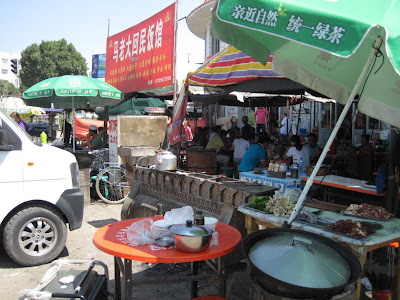 |
| The big black frying pan with warm pilaf inside, and kebabs before it goes to the charcoal grill |
7. Kashgar (喀什)
The most memorable things during our stay in Kashgar are the fruits, lot of fruits, as good as heaven. Kashgar has many cherry trees, and the neighboring county Jiashi has really good melon and apricot. These fruits are listed together with grapes in Turpan, pomegranate in Yecheng, jujubes in Hotan, and fragrance pears in Korla as the best fruits all around China. All these yummy fruits are sweet due to good sunshine and dry weather in the Uyghur region. We happened to catch the season of the melon and apricot. The actual Jiashi melon taste much better than its great reputation. Each melon is about 5 pound, looks like a football, with rough green skin and irregularly patterned lines outside. Inside the melon, the orange colored flesh is crisp and juicy. Once the melon is cut, it looks like a sack made with burlap, with a bag of cool and sweet sun inside.
 |
| Cherry juice, tea pot, and yogurt |
 |
| Melon, apricot, nectarine, watermelon and green figs ... for lunch |
The apricot from Jiashi county is also a real delight. The apricots are small with smooth and shiny skin. They are soft after ripe, very sweet with a slight hint of tartness. I found it was hard to stop eating that apricot once I started. In Kashgar, all the fruits are picked a day before from the tree, all of them are ripe and and ready to eat. And the price? It is incredibly affordable. We had lunch in Jiashi, since we really liked the fresh apricot, our friends send us to the car with a whole box of their apricot. They said the whole box only cost about twenty yuan (3 dollars). We finished about half of it in the next two days. It is not that we get tired of it, it is just because these fruits are highly perishable. These home grown stuff were never sprayed with pesticide, never processed in formaldehyde for longer shelf live. They became soft too quickly. And by the third day, they started to smell like fruit wine, which almost made me wanted to stay and wait for the wine.
The figs in Kashgar makes interesting scenes at every corner of the busy street when they are in season. Different from our California figs which turned purple when mature, Kashgar figs remains green inside and out. The first time I saw those fig was on my way toward the mosque. A old man with long beard and a small green cap was squatting on the edge of the sidewalk. There was a round stool on his side, and a flat iron pot on the stool. On top of the iron pot, there were stacks of greenish flat stuff, looks like some pastries, or squash. I asked the old man what is it. After couple of back and forth, he finally came back with something I could understand, it was sugar buns. Each cost one Yuan (15 cents). After he put the money in is pocket, the old man took a green leaf from the side and warped one fig in the leaf. He then passed it to me and signaled me to eat. I took a bit, hmmm... very soft and sweet, and there are tiny little flowers inside it. It is a fig!
For Uyghur people, their typical meal starts with fruit, all kinds of fruit around season, even in winter. Fruit is their appetizer, after that there are the entrees and naan. The entrees are mostly lamb, cooked in different ways. Even kebab has different styles. Most of the kebabs are made with marbled meat, put through a iron stick or a tamarix branch and grilled with seasons. There are roasted lamp which are made by put the chucks of marinated meat on a iron rack and then roast them in the oven. The lamb can also be stewed, boiled in a soup base... No matter how they made it, it always taste good. The secret is within the sheep. Those sheep were raised up by grazing off the fresh grass with plenty of walking. So the meat is always tender without that funny lamb smell. One of the good dish is made with a whole or half young lamb, boil it in a big pot of water. Then stew for a hour with just onion and pepper in the soup. The dish is served hot with a bowl of dipping sauce, the meat is so juicy without the feeling of greasy, even the soup is awesome.
Another Uyghur specialty is also made with the oven where the Naans are toasted. It is called baked bun. Inside the thin flour shell, they have wrapped chopped pieces of lamb and l sweet onions. The buns then gets roasted tan in the oven and served hot. I really like the crunchy shell outside, and my son liked them so much he ate six buns at dinner. We packed the remaining six buns to go and the next morning, before I even get up, the boy pulled out the box from the night before and finished all the six bus. He claimed that he was too hungry to wait for breakfast. I was totally stunned and slightly grossed out. The hot buns were good because it was crunchy and juicy inside. But after a night in the air conditioned room, all the meat and oil got consolidated into some white stuff, how can he eat six of it and still looking for more?
Baked buns, with lamp filling, so good...
After eating so many sugar-rich fruits and greasy lamp, we thought our bellies would be growing into balloons. But the strange thing is, we didn't gain any weight at all. And if we observe those local people in Kashgar, none of them are fat. All the men seem to be on the slim side while the older women tend to be a bit round. No one weights more than 200 lb. No obesity after all that sugar and animal fat? My theory is that the local diet in Kashgar is rich in fruits and fiber, so the large amount of animal fat is ignored and passed, and not much get to saved on the belly. It feels like a balanced system between the local diet and the local climate. There are a lot of compatibility between the the local habit and the food produced by their land, after hundreds years of development. Such a eating habits is gradually formed by natural evolution, it does not produce obesity. United States, on the other hand, is opposite There is not much history to evolve the living habit with the land. In addition people use chemicals and genetic science to change what the land can produce. Obesity is therefore plenty. With the help of automobile, it is hard to not getting fat.
Kashgar has many good eats in the restaurants. And better yet, while eating, we saw many beautiful artworks of art. Uighur people love music and dance, they love sitting in colorful, beautifully decorated restaurant to enjoy food. From those beautiful arches, fancy stigma, as well as the walls of woodwork, I saw their cultural heritage accumulated over thousands of years. Silk road and the trading has given this city its character and charm. Many, many years ago, Chinese merchants brought bundles of silk here after all the hardships through the desert and sold them to Persians And from here they brought Persian spices and jewelry to bring it back home by camels. Huge profits attracted lots of people who are not afraid of bandit, sandstorm and dehydration. And thanks to the exchange of commodities and the local productive land, people in Kashgar has been enjoying a abundant life. They had the time and resource to study and make art, pass them down from generation to generations. And nowadays, due to the conservative character of Uyghur toward the ethnic majority Han, there are occasional conflicts in the area. Those incident brought SWAP teams to the city but they also saved the city of Kashgar from the annoying bus load of wholesale tourists. We feel fortunate that we had the chance to visit Kashgar in its natural state and with all the good food that comes around.


 |
| Naan |
 |
| artworks in the restaurant |